When discussing sustainable fashion I think it is important that we first look at our own backyard here in New Zealand. In order to do this I will be looking into New Zealands textiles history to get a better understanding around our history with the production of clothing. New Zealands Textiles and Apparels Sectors article written by Laura Jocic offers us a great insight into our history around clothing. Please note that I will be focusing on our immigrants history of textiles and apparel as this relates directly to the current systems of fashion present in New Zealand today. Maori’s history around craftsmanship, weaving, and body adornment are all vital to New Zealands history however the current systems of production and consumption are concepts which is a result of colonialism. With this perspective in mind, I feel it appropriate that we explore the history of imported goods and textile production in New Zealand before we dive into Maori clothing.
Prior to 1830 European settlers were estimated to be less than 1,000 among an estimated 70,000 Maori. By 1881 the number of European immigrants increased to approximately 500,000. When immigrating to New Zealand, immigrants brought over their own ideas around clothing. Immigrant packed clothing with consideration of the climate and geography of the land. The geographical isolation of New Zealand with its location and as a new settlement country, supply of new products was restricted. Material such as woollen goods, silk and cotton were most likely exported from England and Australia. Bear in mind that early settlers had yet to fully establish themselves therefore were still reliant on imported supplies.
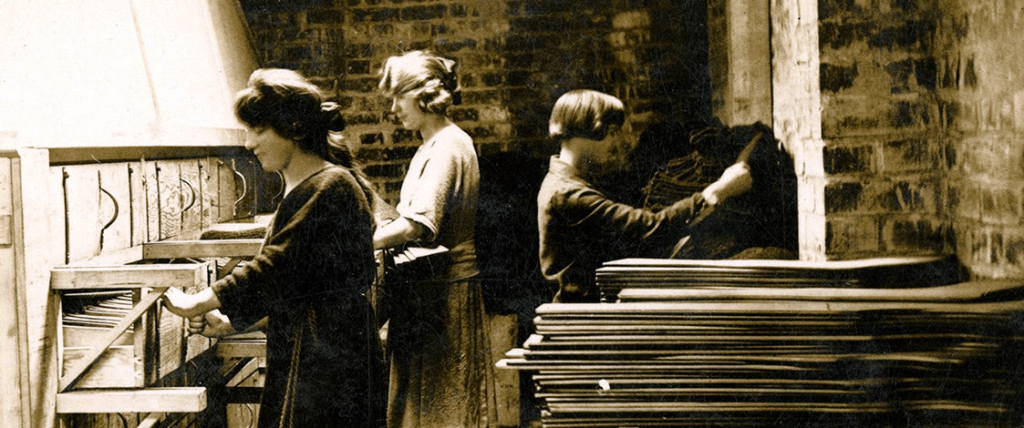
https://nzfashionmuseum.org.nz/manawatu-knitting-mills/
Industries soon developed in New Zealand however competition with British equivalents reportedly stifled domestic industrial development. Woollen mills were established in the 1880s with the production of woollen blankets and boots. Boots and shoes were made from leather produced locally. Gold miners found it difficult to secure appropriate clothing for men thus stimulating the local manufacturing of apparel, textiles, and footwear. By 1862, Hellenstein’s Brothers expanded to New Zealand from Australia and they soon opened up a factory in 1873 due to difficulties with obtaining imports of mens clothing. It was reported that despite a growing manufacturing industry in New Zealand, retailers preferred imported clothing as opposed to locally made products.
Clothing for women and children were made by dressmakers. This dated back to the earliest day of settlement. Dressmakers were either employed is large department stores or worked from their homes. Sewing machines date back as early as 1850s with domestic sewing machines being made available in 1860s. The prevailing fashion trends at the time followed that of Europe fashions of fabrics, designs, and constructions.
New Zealand is largely known for our production of wools and leathers. Tariffs and subsidies were introduced by New Zealand governments to help ongoing development with the countries clothing production and retail industry. From early 1800s to mid 1800s, New Zealand was dependant on imported goods however from mid to late 1800s there was a shift toward self-sufficiency with the production of textiles and manufacturing of clothing/footwear. Leading into the late 1900s through to the early 2000s, we start to see a shift back to a dependency in imported goods with the reduction of tariffs, removal of subsidies and introduction of wholesalers/importers. The cost to produce locally was no longer cost efficient thus production and manufacturing moved overseas. With these changes we have the current fashion system present today with majority of our clothing and footwear being imported from overseas.
The shift from a dependency on imported goods; to being self-sufficient with the production of textiles and manufacturing of clothing; and then back to a dependency and preference for imported goods; was interesting to me. The globalisation of manufactured goods meant that New Zealand also imported unsustainable attitudes toward clothing. Not only did we take on a culture of over consumption but we also took on the use of unsustainable materials. New Zealand has access to beautiful locally produced materials like wool, flax and leathers and yet most of our clothing, being imported, are made from synthetic material like polyesters etc.
My mother used to share stories about how my grandmother would make all their clothes. Being an immigrant family with 9 children, my grandmother took to making her children’s clothes as it was more cost efficient as opposed to purchasing at local department stores as it was far too expensive. Coming through to present New Zealand, massive brands like H&M, Kmart and JayJays can offer clothing at a fraction of the cost with money and time compared to if you were to make your own clothes. The cost of fabric, thread, buttons/zippers etc all add up and tend to be more than if you were to purchase a $5.00 t-shirt or $10.00 dress online. Here we see how the low cost of clothing and shift to imported goods feeds our growing appetite for consumption and lack of awareness for the impact of the fashion industry on the environment.
After looking into the history of New Zealand’s textile production, I feel that it would be beneficial for us to return to the period of self-sufficient production and manufacturing. I believe that when goods are produced and manufactured locally, we are more conscious of the use of sustainable and environmentally safe methods. When goods are produced overseas, it easier to ignore the environmental and social impacts of fast fashion as it is so far removed from the tangible realities of our world. Not only do we have this immigrant history of a self-dependant and environmentally sustainable methods of productions but we also have the Maori ethos of respect for land with a culture of deep connection to clothing and the making of clothes to turn to. By adopting both aspect of New Zealand history, we can have a rich and diverse catalogue of ecological design principles, practices and processes while also sustaining the cultural heritage of Maori and New Zealand settlers.
Bibliography:
Jocic, Laura. “New Zealand Textiles and Apparel Sector.” In Berg Encyclopedia Australia, New Zealand and the Pacific Islands Vol 7, 298-304. Berg Publisher 2011.
Ian Matheson City Archives. Women at work at the Manawatu Knitting Mills, circa 1925. Image courtesy of Ian Matheson City Archives. January 2016. New Zealand Fashion Museum. https://nzfashionmuseum.org.nz/manawatu-knitting-mills/.
 Seini's Blog for Earth-Centred Design and Cultural Sustainability