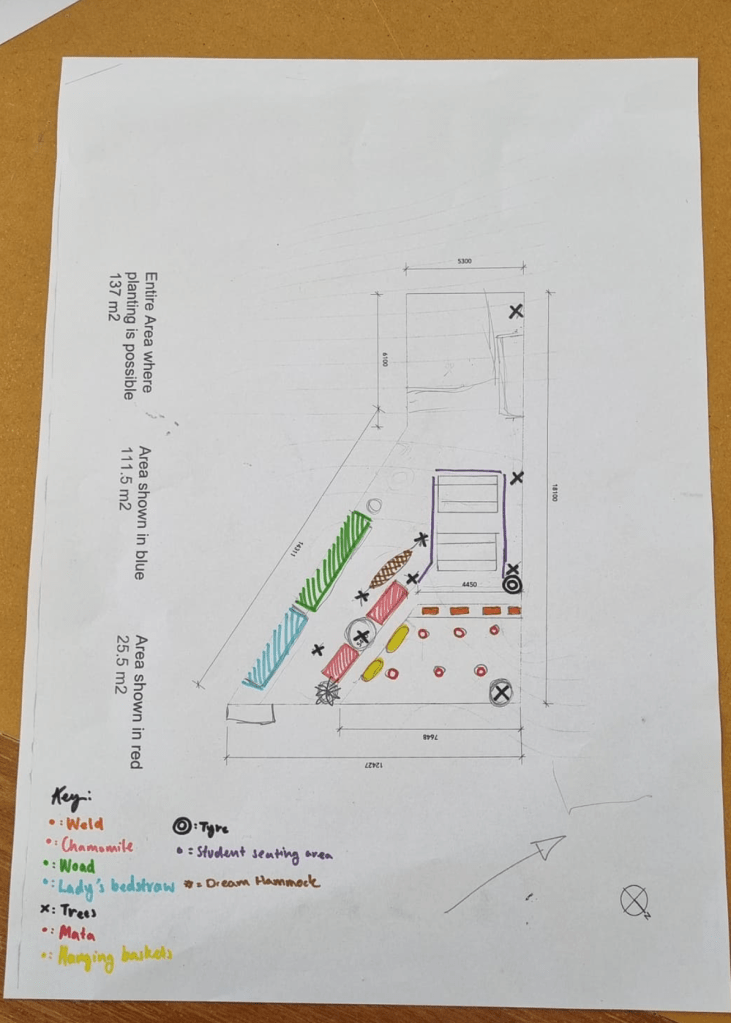
In week 4 we had weeded our dye garden in preparation the new plants. The plants were selected for their ability to extract beautiful vibrant colours. In our allocated groups, we were given the task of drafting a plan for where each plant would be placed. We researched each plant to ensure that they placed in best location that would allow them to healthily flourish.
Weld is a blooming plant that displays dark green, ovoid leaves and spiky yellow or greenish white flowers with orange stamens. Weld wields a bright yellow colour. It was used in Roman times to dye fabric and in the making of oil paints. The plant also has a beautifully strong sweet scent and was used in Victorian times to hide unpleasant odors. As a biennial plant, weld develops a basal rosette in the first year and flowers the second year. The plant only lives for 2 years but drops enough seeds meaning there is a continuous blood each year. Weld grows best in moist to slightly dry soil. Weld needs full or partial sunlight to flourish which is why we positions the plant right above the madder as the this where the sunlight hits best during the day.
Chamomile blooms beautiful white flowers with a contrasting yellow centre. Chamomile is used in teas, cosmetics, for decorative purposes and medicines. There over 4 different types of chamomile with Chamaemelum nobile and Matricaria recutita being the main 2. Chamomile produces a lovely yellow colour when extracted and so would make a lovely addition to the natural dye garden. This plant grows between 1 and 2 feet tall and is generally used abound gardens beds. In order for chamomile to thrive, it needs to be in full sun. It is best to space the seeds/plants about 4 to 8 inches apart. The area is to be kept moist and the weeds to cleared to ensure the health of the plant. We positioned the plant just above the madder to the left of the garden bed. This area gets a generous amount of sun during the afternoon which is ideal for chamomile.
Woad is an erect biennial meaning it has a 2 year biological cycle. The first season being with seeds that produce the root structure, stems, and leaves. The second season of biennial plant growth is when the plant flowers, fruit, and seeds. Woad was preferred plant for blue dye extraction in Europe before Indigo was introduced by Eastern Indian merchants. As you may have figured our with my reference to indigo, woad produces a blue colour. Woad grows like a weed therefore it is low maintenance. Bear in mind, woad can displace valuable crops and so it is important to consider this when planting the crop in your garden. The plant has a long tap root growing up to 3-5 feet. Due to the height in which woad can grow and the fact that the plant is invasive in its growth, we placed the plant along the build wall as this should act as a supporting backdrop for the crop. This area does not get too much sunlight which should not impact the growth of the woad plant.
Lady’s Bedstraw is a perennial herb meaning this plant lives year after year. This plant has over 400 varieties of Galium with the most popular being the Galium odoratum commonly known as sweet woodruff. Before mattresses and pillows with man-made fibers were introduced, Lady’s Bedstraw was often used as stuffing. It was considered good luck to use the plant as the mattress stuffing for expecting mother. Lady’s Bedstraw flowers yield a yellow colour and the roots a deep red or browns. The plant is drought tolerant and can become invasive. It grows in full sun or part shade. As you can see below, we placed the Lady’s Bedstraw next to woad as both plants require low maintenance and grow aggressively. The placement of the plants are separate from the other plants.
Our approach with the natural dye garden is to avoid the use of pesticides and to move away from the tendency to destroy native New Zealand plants. We have been careful not to remove any trees or plants native to the area as we do not want to jeopardise the natural ecosystem of the space. Throughout the discussions with Maori weavers, which you will see in my week 10 post, it is important to respect the life of plants. This means that when we harvest or plant new crops, we have to consider all living things in the space. The belief that we are all interconnected also influences the way Maori people view nature which we can see through the Maori interpretation of the Treaty of Waitangi – see post day 4. Working with our natural dye garden has showed me the importance of returning to indigenous or old methods of farming. By doing so we will be able to repair the soil and most importantly, our relationship with Mother Nature and our spiritual selves. The trickle effect hopefully being a shift in our attitudes with consumption and our dependance on the current economic system.
Bibliography:
Dyer, Mary H. “Weld Plant Information: Learn About Growing Weld Plants.” Web log. Gardening Know How (blog). Credentialed Garden Writer, Autumn 2023. https://www.gardeningknowhow.com/ornamental/flowers/weld-plant/weld-plant-information.htm.
Grant, Amy. “Chamomile Lawn Plants: Tips For Growing Chamomile Lawns.” Web log. Gardening Know How (blog). Credentialed Garden Writer, Autumn 2023. https://www.gardeningknowhow.com/lawn-care/lawn substitutes/chamomile-lawn/growing-chamomile lawns.htm#search/q=Roman%20vs.
Larum, Darcy. “Roman vs. German Chamomile-Learn About Different Types od Chamomile.” Web log. Gardening Know How (blog). Credentialed Garden Writer, Autumn 2023. https://www.gardeningknowhow.com/edible/herbs/chamomile/roman-vs-german-chamomile.htm.
Grant, Amy. “Woad Plant Care: Tips On Using Woad Plant Dyes.” Web log. Gardening Know How (blog). Credentialed Garden Writer, Autumn 2023. https://www.gardeningknowhow.com/ornamental/flowers/woad-plant/woad-plant-care.htm.
Grant, Amy. “Biennial Plant Information: What Does Biennial Mean.” Web log. Gardening Know How (blog). Credentialed Garden Writer, Autumn 2023. https://www.gardeningknowhow.com/garden-how-to/info/biennial-plant-information.htm.
Larum, Darcy. “Lady’s Bedstraw Plant Info – How To Grow Lady’s Bedstraw Herbs.” Web log. Gardening Know How (blog). Credentialed Garden Writer, Autumn 2023. https://www.gardeningknowhow.com/edible/herbs/ladies-bedstraw/grow-ladys-bedstraw-herbs.htm.
Grant, Amy. “Perennial Garden Plants: What Is A Perennial.” Web log. Gardening Know How (blog). Credentialed Garden Writer, Autumn 2023. https://www.gardeningknowhow.com/garden-how-to/info/perennial-garden-plants.htm.
 Seini's Blog for Earth-Centred Design and Cultural Sustainability