Te Tiriti O Waitangi by Margaret Kawharu
When exploring the theme of sustainable fashion it is vital that we look to ourselves and first explore the culture and history of Aotearoa. Margaret offered us a great insight into the founding document of New Zealand being the Treaty of Waitangi or Te Tiriti O Waitangi.
Te Tiriti O Waitangi
- The Treaty of Waitangi was signed in 1840
- The treaty was an agreement between the crown and the native tribes of New Zealand/Maori people
- The Treaty was signed by 50 chiefs after having had been presented to about 500 Maori chiefs
- The Treaty was not taking to all regions within New Zealand thus not all Maori tribes were given the opportunity to participate in the signing of the Treaty
Throughout the presentation Margaret explained that the intensions behind the Treaty were to protect the independence and rights of the Maori people due to the influx of immigrants, merchants and sailors moving through and to the land. New Zealand was supposedly used as a trial on how to govern a country through partnership rather than the traditional colonial rule of claiming sovereignty over land, resources and people. During the period of 1810-1820, India was fighting for independence from the British crown, there was the revolutionary war in America and there was the slave rebellion in Barbados. Margaret pointed out that with the conflicts in the crowns outer colonies, this was the motivating force behind their want to somewhat assist the Maori people by way of a Treaty. I think it important to understand that during this period, Germany and France had occupied parts of pacific and both the Crown and the Maori people were aware that Germany and France would soon find their way to New Zealand. After speaking with members of tribes from the South Island as well as the upper North Island, I have come to find that the Maori peoples intentions with the Treaty was to confirm their independence from the Crown as a self governed people. The Maori people also understood the Treaty to be an agreement for the Crown to govern British settlers who were migrating to New Zealand.
I found this to be an interesting shift around the interpretation of the Treaty’s intentions as my previous experience when learning about the Treaty of Waitangi was that it was an attempt by the crown to claim sovereignty over Maori land, Maori people and their resources. This interpretation is consistent with the treatment of Maori peoples throughout New Zealands history with the confiscation of Maori land under the New Zealand Settlement Act 1863, Maori language officially being discouraged within New Zealand schools in 1903 to the urbanisation of Maori families in the 1960s where Maori people had to pay the price of sacrificing their culture and tradition in order assimilate to urban life.
What role does the Treaty of Waiting have to play in sustainable fashion and design. This became more evident when Margret went into the translation of the treaty which I feel provided a clear link between sustainability and how we as future fashion designers can implement these ideas into our work. When looking into the history of the Treaty of Waitangi, we will see there has been an ongoing dispute around the interpretation of the treaty and how the intentions of each side have influenced the meaning of what the Treaty stands for today. Maori people have the belief that they are custodians of the land. As custodians of the land, their role is to protect, sustain and live with nature. The crowns relationship with land and nature has been one of ownership and consumption. Here we can see how the differing relationships with nature and land would lead to a misunderstanding from the offset. Unfortunately this misunderstanding would be the result of growing mistrust between the crown and the Maori people.
Research:
- Te Ara – New Zealand Encyclopaedia: https://teara.govt.nz/en/urban-maori/page-1
- The British Empire – 19th Century Timeline: https://www.britishempire.co.uk/timeline/19century.htm
- Tupu.NZ – About Maori Land in New Zealand: https://www.tupu.nz/en/tuhono/about-maori-land-in-new-zealand/history-of-maori-land
- The impact of colonisation on te reo Maori: A critical review of the State education system by Rachel Ka’ai-Mahuta
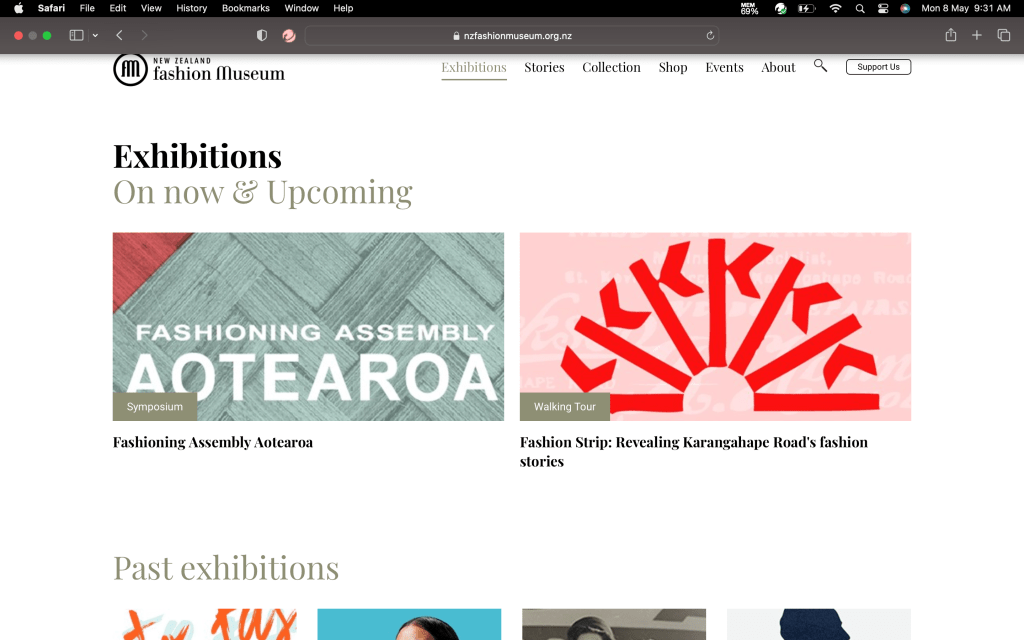
Doris De Ponte – Fashion Museum
Doris De Ponte established the Fashion Museum after having had seen the lack of acknowledge around the importance of fashion and clothing throughout time. Doris expressed her want to showcase clothing as a powerful tool to discuss history, as a way of understanding technology and how it can be used as a way to analyse social economic relationships throughout time.
The museum is digitally accessible online and does not have a permanent physical presence. This allows for accessibility and range in the sense that artefacts/clothing can be from a number of difference places and locations. With the advances in technology, they are able to showcase the different textures, stitches, colours and shapes of each garment.
The Fashion Museum us a great resource as it allows us to explore the story behind different types of garments, fabrics and designers. It displays clothing in a deeper sense as it dives deep beyond the surface. We are able to learn about the inspiration, the drive and the intention of designers and how each piece has been interpreted within a social context. I think this is quite beautiful as the intentions of a designer tends to be received differently by society and the way this influences groups as a whole will differ from that of an individual person.
 Seini's Blog for Earth-Centred Design and Cultural Sustainability